
Introduction
Cybersecurity is a practical field that requires more than theoretical knowledge. Organizations today expect cybersecurity professionals to understand real-world attack scenarios, security tools, and incident response processes. Hands-on cybersecurity training helps learners gain practical exposure and prepares them for real industry environments.
Importance of Practical Learning
Practical learning allows learners to:
- Work with real security tools
- Investigate cyber incidents
- Analyze logs and alerts
- Understand attacker techniques
- Improve problem-solving skills
Hands-on practice helps learners build technical confidence and industry-ready skills more effectively than theory alone.
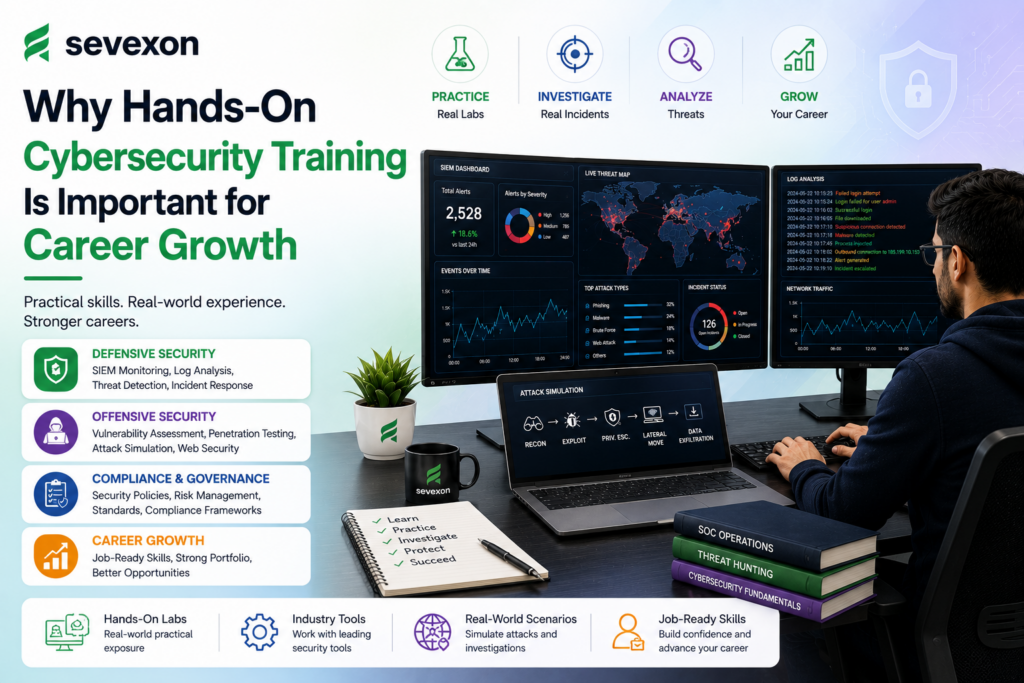
Exposure to Offensive and Defensive Security
Practical cybersecurity training provides exposure to both offensive and defensive security domains.
Offensive Security
Learners understand:
- Vulnerability assessment
- Reconnaissance techniques
- Security testing basics
- Web application security concepts
- Common attack methodologies
Defensive Security
Learners gain experience in:
- SIEM monitoring
- Log analysis
- Incident response
- Threat detection
- Endpoint security monitoring
Understanding both domains helps professionals build a stronger cybersecurity foundation.
Real-World Security Scenarios
Cybersecurity professionals regularly deal with:
- Phishing attacks
- Malware infections
- Unauthorized access attempts
- Suspicious network activity
- Endpoint security alerts
Hands-on labs simulate these scenarios and help learners understand how security investigations are performed in real environments.
Security Tools and Technologies
Practical training helps learners work with industry tools such as:
- Splunk
- Microsoft Sentinel
- QRadar
- Wireshark
- Endpoint security solutions
- Vulnerability assessment tools
Exposure to these tools improves technical understanding and operational confidence.
Governance and Compliance Awareness
Modern cybersecurity also requires awareness of governance, risk, and compliance concepts such as:
- Security policies
- Risk management
- Security standards
- Compliance frameworks
- Security awareness practices
Understanding compliance concepts helps learners build broader cybersecurity knowledge beyond technical operations.
Career Preparation and Growth
Hands-on projects, labs, and practical investigations strengthen resumes and improve interview performance. Organizations prefer candidates who understand real-world cybersecurity operations and practical workflows.
Cybersecurity career opportunities include:
- SOC Analyst
- Penetration Tester
- Threat Intelligence Analyst
- Security Engineer
- GRC Analyst
- Incident Responder
- Cloud Security Analyst
Conclusion
Hands-on cybersecurity training is one of the most important factors in becoming a successful cybersecurity professional. Practical exposure helps learners improve technical skills, build confidence, understand real-world security operations, and prepare for long-term career growth.
At Sevexon, we focus on practical cybersecurity learning through hands-on labs, real-world scenarios, and career-focused guidance to help learners become job-ready professionals.